PDF Compressor
Compress PDF files online free — shrink large PDFs for email, uploads and forms without losing readability. No upload, no signup: runs 100% in your browser.
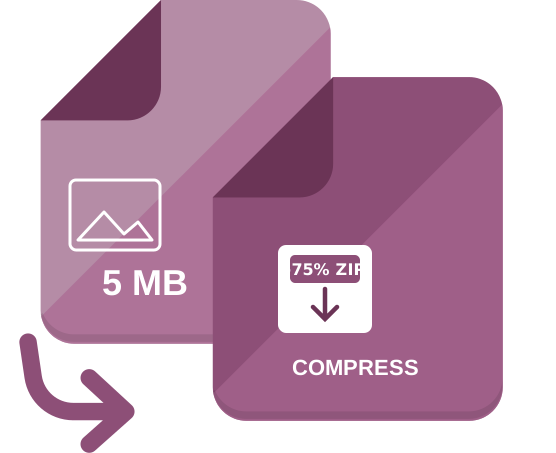
A PDF compressor reduces the file size of a PDF so it fits an email attachment limit or an upload cap. ToolJiffy does this entirely inside your browser: your document is re-rendered locally at a lower resolution, re-encoded, and rebuilt as a smaller PDF. Nothing is uploaded, and the result downloads instantly.
What this compressor actually does to your PDF
Most size problems in a PDF come from one place: oversized embedded images. A phone photo or flatbed scan carries far more pixel data than any screen or office printer can use, and a twenty-page scan can easily reach 40MB. ToolJiffy renders each page with pdf.js, re-encodes it as a JPEG at the quality you choose, and writes the result into a new document with pdf-lib. Page dimensions stay identical, so margins, aspect ratio, and print size are unchanged.
Being direct about the trade-off: this is a rasterising compressor. Every page comes back as an image, which means selectable text, hyperlinks, form fields, and bookmarks do not survive the round trip. That is exactly what you want for a scanned contract, and exactly what you do not want for a text-native report you still need to search. If you need the text layer back, run the output through ourOCR PDF tool to rebuild a searchable layer over the compressed pages.
Which compression preset should you choose?
- High Quality (80%) renders at double scale with light JPEG compression. Best when the file will be printed or read closely, such as signed paperwork and legal exhibits. Savings are modest.
- Balanced (70%) is the recommended default and typically lands a 60 to 80 percent reduction while staying comfortable to read on a laptop or phone.
- Max Savings (55%) renders at the lowest scale with the strongest JPEG setting. Reach for it when a government portal or job application form enforces a hard 1MB or 2MB ceiling.
You can switch presets after loading a file and the document is re-compressed immediately, so comparing all three against a size target takes seconds.
ToolJiffy compared with cloud compressors and desktop software
| ToolJiffy | Typical online compressor | Desktop PDF software | |
|---|---|---|---|
| File leaves your device | Never | Yes, uploaded to a server | Never |
| Account or sign-up | None | Often required past a few files | Licence or subscription |
| File size cap | Your device memory | Commonly 10–100MB on free tiers | None |
| Watermark on output | None | Sometimes on free tiers | None |
| Install needed | No | No | Yes |
| Keeps text selectable | No — pages are rasterised | Often yes | Yes |
| Price | Free, unlimited | Free tier, then paid | Paid |
When this is the wrong tool for the job
A compressor is not always the answer. If your PDF is large because it has 400 pages rather than heavy images,splitting it into sections will serve you better than degrading every page. If you only need a handful of pages, extract those pages instead. And if you are compressing because a page contains a large photo you control, compressing thatimage on its own before building the PDF gives a cleaner result than re-encoding the finished document.
Privacy when the document is an ID, contract, or bank statement
Scanned passports, tax returns, payslips, and signed agreements carry personally identifiable information. Sending them through a third-party server means trusting that company's retention policy, staff access, and breach history. Local processing removes that question entirely: there is no upload, no temporary copy on a remote disk, and nothing to delete afterwards. Stripping document metadata separately with ourPDF metadata remover is a sensible second step before sharing.
Step-by-step: compress a PDF in your browser
- Drop a PDF onto the drop zone, or pick one from your device or connected cloud storage.
- Choose a compression preset. Balanced is the right starting point for almost every file.
- Read the before and after sizes plus the percentage saved, shown as soon as the pass finishes.
- Download the compressed PDF, or switch presets and compare before committing.
Frequently Asked Questions
How do I compress a PDF online without uploading it to a server?
Drop your PDF into the tool above. ToolJiffy loads the file into your browser’s memory, re-renders every page with pdf.js, and rebuilds a smaller PDF with pdf-lib. There is no upload step and no server involved, so the document never leaves your computer or phone.How does this client-side PDF compressor actually work?
Each page is rendered to a canvas at a reduced resolution, encoded as a JPEG at the quality level you pick, then placed into a fresh PDF at the original page size. That single pass removes bloated embedded images, duplicated resources, and leftover metadata in one go.Will the text in my compressed PDF still be selectable and searchable?
No, and this is the honest trade-off. Because every page is re-encoded as an image, the output is a picture of your document rather than live text. If you need selectable text afterwards, run the compressed file through our OCR PDF tool to add a searchable text layer back.Which kinds of PDF shrink the most with this tool?
Scanned documents and image-heavy files shrink dramatically, often by 60 to 80 percent, because camera and scanner images carry far more data than a screen needs. PDFs that are mostly vector text are already small and may barely shrink at all.What happens if the compressed file comes out larger than the original?
The tool tells you plainly and shows a zero-percent reduction instead of handing you a worse file. That usually means the PDF was already optimised. Keep your original in that case, or try the Max Savings preset to see if a lower quality level helps.Can I compress a password-protected PDF?
No. Encrypted PDFs cannot be read in the browser, so the tool stops and tells you to remove the password first. Open the file in your PDF reader, save an unprotected copy, then compress that copy here.How do I get a PDF under a strict 1MB or 2MB upload limit?
Start with the Balanced preset and check the reported output size. If it is still over the cap, switch to Max Savings, which renders at a lower resolution and a stronger JPEG setting. Splitting a long document into smaller parts first also helps.Is the ToolJiffy PDF Compressor free, and are there any file size limits?
It is completely free with no account, no watermark, and no daily quota. The only practical ceiling is your own device memory, since very large documents with hundreds of high-resolution pages need RAM to render page by page.